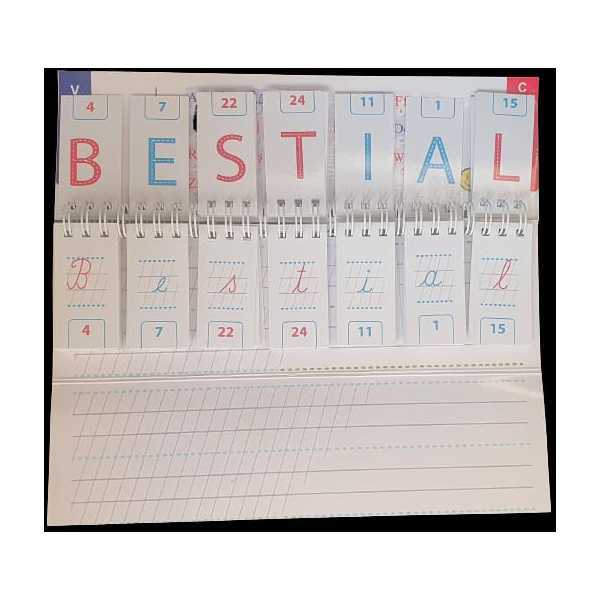
CL1 SMART ALPHABET
ComPlet ALPHABET: Write and discover, learning through play! Colorful education and inspiration! | Named
BUY NOW →Product Code: D1041
ALPHABETAR ComPlet The product - ALPHABETAR is intended for students who want to easily learn to write and read in Class 1
The colored MAGIC BOOKS work wonders when you outline the letters of the alphabet!
The ALPHABETAR was designed so that it is
1) easy to handled;
2) easy to transport;
3) easy to disinfect;
4) to allow quick writing of words.
Pedagogical recommendation:
We warmly recommend using the ALPHABETAR together with the board 0-31 for an INCREASED EFFICIENCY. The ALFABETAR plansa set can significantly improve your child's cognitive ability.
Use the NumLit principle in the teaching method: the active joining between the letter and the corresponding number from the alphabet allows the child to discover and learn math and communication concepts through play.
"To check if he reads mechanically or consciously, I decided to write him one word at a time (Alfabetarele NumLiT) and he asks me: "I'm looking for it at 22"! I didn't even notice the numbers!
8 cm (closed) 24 x m x 19 cm (open)
Materials included in ALPHABETAR:
• cardboard,
• polypropylene,
• metal spring
The school ALPHABETAR set includes:
• 7 groups of 32 tokens each with letters in the mirror The letter of print and the letter of the hand orthographic signs. . -, ? ! caught in a metal spring, which are printed in such a way that the word appears in the mirror, written in small letters and in large print letters.
• NumLit table on the inside of the cover - it has the role of orienting the student. It displays the letters of the alphabet (vowels-purple, consonants-orange) and their position in the alphabet. Thus, students easily write any word with the help of the sequence number of each letter, according to the NumLit principle.
Some exercises / games, for integrated teaching, which can be developed with the alphabet in the preparatory class
1. What number does it have? – a letter is pronounced and the children identify the number associated with it
2. what letter is it – a number is said and the children identify the corresponding letter
3. How do I write correctly? - correct spelling of proper nouns;
4. Read the new word! - observing the changes made to a word by: articulation, changing a letter;
5. writing words with given letters or syllables;
6. dividing a word into syllables
7. Make a sentence! - composing sentences by writing words in teams;
8. identifying the numerical string of the word using the numbers given in the bottom borders of the letter coupons;
9. organization of the numerical string - ascending / descending
10. exercises of ... starting from the numerical string of the word;
a. numeration
b. additions and subtractions
11. Who are the neighbors?
1. ---- a number is said and the children identify its neighbors using cover 2 of the alphabet book (fig. 2);
2. ---- a letter is said and the children identify the number matched to the digit and determine its neighbors using cover 2 of the alphabet book (fig. 2);
4) Collect Letters - we identify the learned letters, write them in notebooks together with the numerical correspondent and form ascending, descending, addition and subtraction strings with or without crossing over the order;
5) Words in the given focus - we use letters of at the beginning, middle or end of the alphabet to fit the program specifications!
12.The secret message - the children are given a series of numbers with the help of which they can find out the transmitted message ( example: 12, 17, 27,1,25,2-19,21,1,17-13,18,1,5,2=Learn through play. )
13. Forming words starting from a number/number range
The NumLit method ensures, through GAME, the balance between the cerebral hemispheres and allows the child to learn easily. More games can be found here; http://numlit.ro/PRODUSE/
Helpful materials in the didactic process;
1. magnetic board alphabet with 8 or 9 sets of letters
2. dry erase boards for student and magnetic board
3. notebooks with special integrated rulers.
4. the Table of addition and Table of subtraction boards
5. The board 0-31 or SMART 31
By using the alphabet individually, important objectives for the young school age will be achieved:
1. formation of reading-writing skills;
2. viewing, knowing and understanding upper and lower case letters
3. writing in the mirror with capital letters, respectively small print letters, of the same word;
4. the differentiated writing of nouns (common, proper) because the first column of letters has capital letters on both sides of the tokens;
5. achieving interdisciplinarity by associating the letter with a number (useful in identifying the position of the letter in the row of tokens);
6. observing the changes made to a word by changing/adding a letter.
Created and Produced in Romania. NumLit products are protected by international copyrights.
Copying, partial or complete reproduction, any other action that may harm the interests of NumLit are strictly prohibited.
NumLit friends are invited to the NumLit Education facebook group where they can discover and share the experiences lived with our products. Visit the NumLit channel on YouTube: https://www.youtube.com/c/NumLit
Customer Reviews
To check if he reads mechanically or consciously, I decided to write him one word at a time (Alfabetarele NumLiT) and he asks me: "I'm looking for it at 22"! I didn't even notice the numbers! 8 cm (closed) 24 x m x 19 cm (open)Materials included in ALPHABETAR:• cardboard,• polypropylene,• metal springThe school ALPHABETAR set includes:• 7 groups of 32 tokens each with letters in the mirror The letter of print and the letter of the hand orthographic signs. . -, ? ! caught in a metal spring, which are printed in such a way that the word appears in the mirror, written in small letters and in large print letters.• NumLit table on the inside of the cover - it has the role of orienting the student. It displays the letters of the alphabet (vowels-purple, consonants-orange) and their position in the alphabet. Thus, students easily write any word with the help of the sequence number of each letter, according to the NumLit principle.Some exercises / games, for integrated teaching, which can be developed with the alphabet in the preparatory class1. What number does it have? – a letter is pronounced and the children identify the number associated with it2. what letter is it – a number is said and the children identify the corresponding letter3. How do I write correctly? - correct spelling of proper nouns;4. Read the new word! - observing the changes made to a word by: articulation, changing a letter;5. writing words with given letters or syllables;6. dividing a word into syllables7. Make a sentence! - composing sentences by writing words in teams;8. identifying the numerical string of the word using the numbers given in the bottom borders of the letter coupons;9. organization of the numerical string - ascending / descending10. exercises of ... starting from the numerical string of the word;a. numerationb. additions and subtractions11. Who are the neighbors?1. ---- a number is said and the children identify its neighbors using cover 2 of the alphabet book (fig. 2);2. ---- a letter is said and the children identify the number matched to the digit and determine its neighbors using cover 2 of the alphabet book (fig. 2);4) Collect Letters - we identify the learned letters, write them in notebooks together with the numerical correspondent and form ascending, descending, addition and subtraction strings with or without crossing over the order;5) Words in the given focus - we use letters of at the beginning, middle or end of the alphabet to fit the program specifications!12.The secret message - the children are given a series of numbers with the help of which they can find out the transmitted message ( example: 12, 17, 27,1,25,2-19,21,1,17-13,18,1,5,2=Learn through play. )13. Forming words starting from a number/number range The NumLit method ensures, through GAME, the balance between the cerebral hemispheres and allows the child to learn easily. More games can be found here; http://numlit.ro/PRODUSE/Helpful materials in the didactic process;1. magnetic board alphabet with 8 or 9 sets of letters2. dry erase boards for student and magnetic board3. notebooks with special integrated rulers.4. the Table of addition and Table of subtraction boards5. The board 0-31 or SMART 31By using the alphabet individually, important objectives for the young school age will be achieved:1. formation of reading-writing skills;2. viewing, knowing and understanding upper and lower case letters3. writing in the mirror with capital letters, respectively small print letters, of the same word;4. the differentiated writing of nouns (common, proper) because the first column of letters has capital letters on both sides of the tokens;5. achieving interdisciplinarity by associating the letter with a number (useful in identifying the position of the letter in the row of tokens);6. observing the changes made to a word by changing/adding a letter. Created and Produced in Romania. NumLit products are protected by international copyrights.Copying, partial or complete reproduction, any other action that may harm the interests of NumLit are strictly prohibited.NumLit friends are invited to the NumLit Education facebook group where they can discover and share the experiences lived with our products. Visit the NumLit channel on YouTube: https://www.youtube.com/c/NumLit