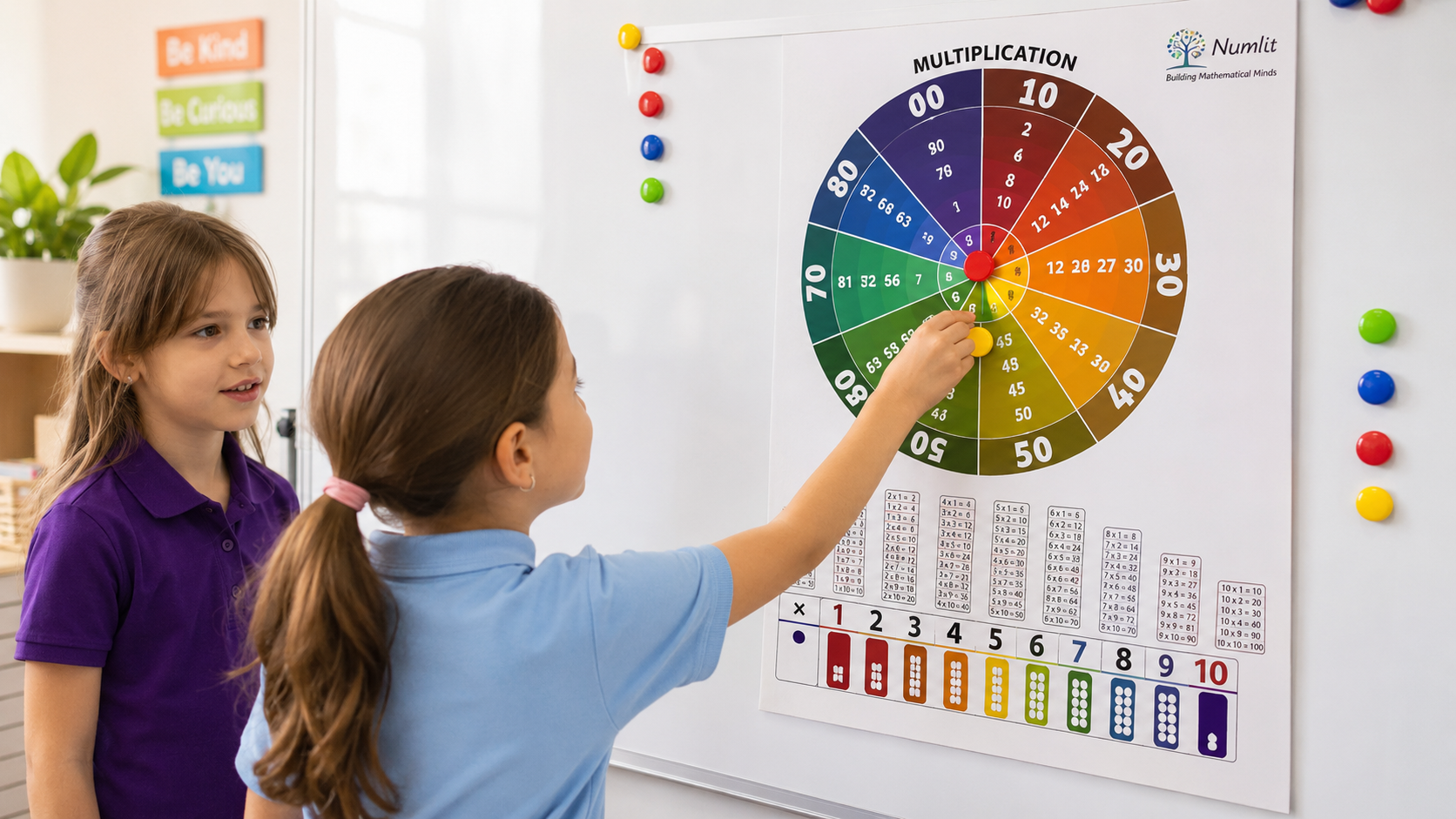
For many children, the multiplication table at first seems like a long list of results to be memorized. 2x7, 6x8, 9x4, 7x8 — all seem like separate information, hard to remember and easy to confuse.
NumLit changes that perspective.
Among the methods used to learn multiplication, two of the simplest variants are designed by NumLit: NumLit reverse method and column learning. They do not start from mechanical memorization of all operations, but from orientation, grouping, logic and play.
The methods are available in many forms: games, workbooks, stickers, magnets, digital games and reusable products, so that learning becomes visible, active and easier to repeat.
1. Learning begins with orientation
To a child, the multiplication table can seem like an unknown city. There are many numbers, many results, many combinations and too few clear benchmarks.
If he doesn't know where he is, the child gets lost easily. He forgets results, confuses operations and constantly needs explanations.
The NumLit method begins by giving the child a map.
Instead of learning the multiplication table as a long list of calculations, the child starts from the center 0-100 and discovers that not all numbers there are products of multiplication.
NumLit's inverse method removes the values that are not produced, and the child is left with 42 unique numbers. These are then grouped into columns so that the child's mind sees order, not chaos.
👉 the child no longer sees the multiplication table as a hard-to-memorize list
👉 the numbers are logically grouped
👉 the results become visual landmarks
👉 learning begins with orientation, not with the pressure of memorization
2. From 0-100, only the numbers that count
remainClassically, the child is made to memorize the multiplication table from 1 to 10, row by row: the 2's table, the 3's table, the 4's table and so on.
The problem is that many results are repeated.
For example:
7x8 and 8x7 give the same result: 56.
6x4 and 4x6 give the same result: 24.
3x9 and 9x3 give the same result: 27.
NumLit simplifies the process.
Instead of insisting on all combinations, the reverse method starts from the results. The child sees the product, places it in a system and then discovers the operations that form it.
Thus, learning becomes clearer.
We no longer have dozens of separate calculations, but 42 essential results, organized by columns.
👉 less seemingly separate information
👉 more connections between results
👉 more visual order
👉 less mechanical memorization
The child is not obliged to remember everything at once. Learn to recognize structure.
3. Reverse NumLit method: the product becomes the starting point
In the classic method, the child starts from the operation:
7x8 = 56
In the reverse NumLit method, the child starts from the result:
56 = 7x8
This change seems simple, but it is very important.
The child is no longer just looking for the answer. The child learns to look at the number as a construction.
56 is no longer just a result to memorize. It becomes a number with identity, a landmark, a link between 7 and 8.
This is where the NumLit mental anchors come in.
For example:
56 is equal to 7 times 8 because 7 and 8 follow 5 and 6.
This association helps the child link the outcome to a mental image that is easy to remember. Instead of memorizing in isolation, he constructs a logical story.
👉 56 is no longer a random number
👉 7x8 is no longer an abstract combination
👉 the child receives a mental anchor
👉 memory is supported by logic and image
4. Columnar learning reduces time and increases clarity
After the non-producing numbers are removed, the remaining 42 numbers are grouped into columns.
This organization completely changes exper