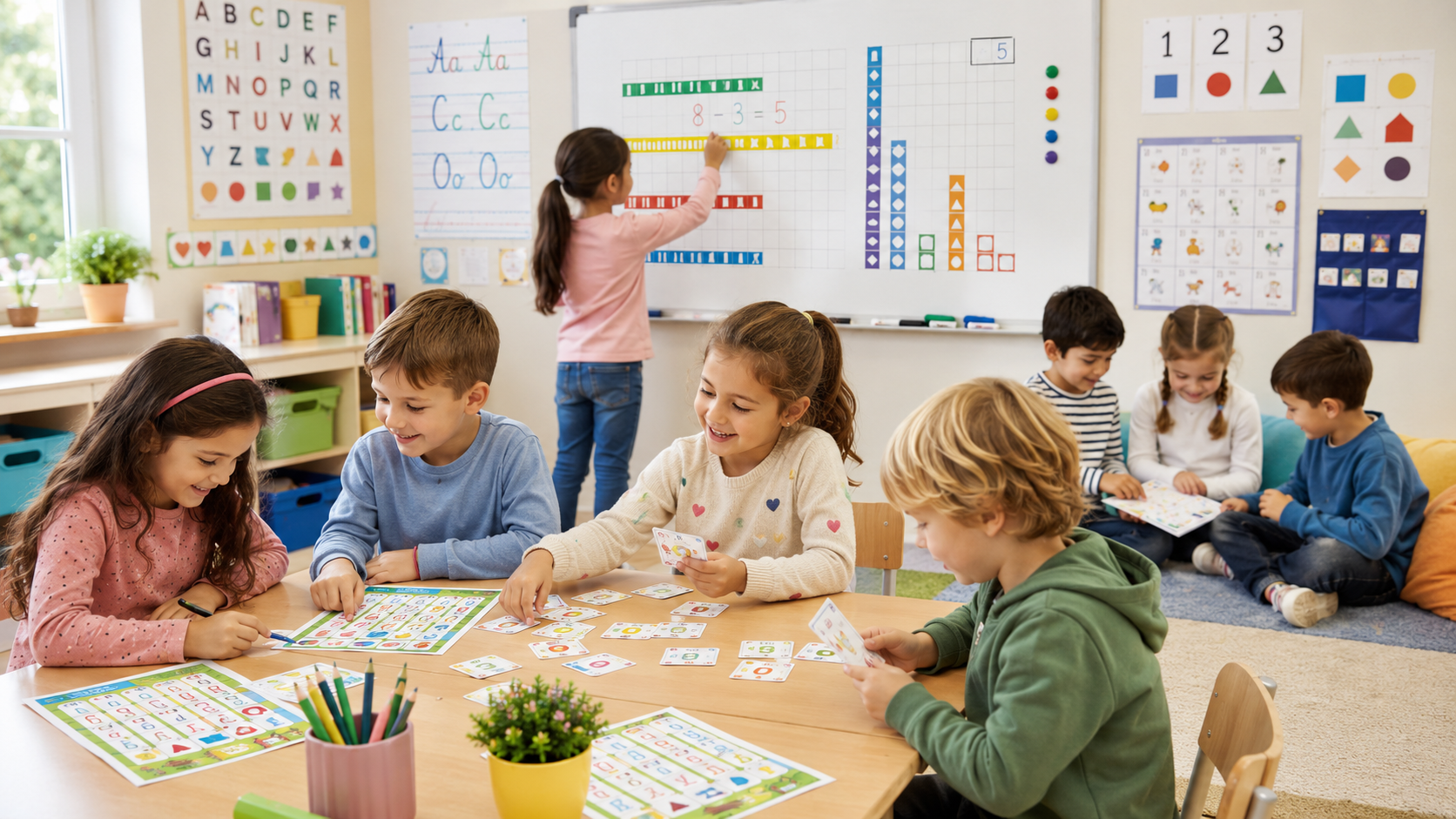
A mind that learns more easily, maybe faster and more
1. Learning begins with orientation
For a child, letters, numbers and symbols are like an unknown city. If he does not have stable landmarks, he easily gets lost, forgets, confuses and constantly needs explanations.
NumLit builds these landmarks through clear connections between the letter, its position in the alphabet, number, color and geometric shape.
Just as road signs help you find your way around a new city, the principles of NumLit help your child navigate CLR and MEM.
👉 the child recognizes more easily (involuntarily learns the alphabet in about 1-2 weeks)
👉 make logical connections (over 30 games available)
👉 learn with less effort
👉 gain confidence in your own reasoning
2. Letter becomes Number. The number becomes the image.
NumLit does not treat letters and numbers as separate information. It puts them in relation.
The letter has a position in the alphabet. Position becomes number. The number is supported by color. Color is related to a geometric shape.
Thus, the child does not memorize mechanically, but builds a mental map.
Information reaches him through several ways: visually, logically, verbally and through action. This is exactly where the major advantage appears: the child understands before he is forced to remember.
👉 the letter is no longer a simple sign (alfabetar)
👉 the figure is no longer an abstract symbol (mathematicar)
👉 color becomes code (ruglete)
👉 the form becomes a benchmark (from here I start fluent reading and all mathematics up to the 3rd grade - for example multiplication by repeated addition)
3. Memorization becomes logical, involuntary
When the same connections are repeated through play, exercises and visual materials, the child begins to recognize them automatically.
It is the same mechanism that we see in traffic signs or riding a bicycle. At first, everything seems new. Then, through stable benchmarks and repeated experience, the reaction becomes natural.
The child no longer makes an effort to memorize each element separately. Recognize the pattern. Make the connection. Answer more confidently.
This is the power of NumLit: it turns memorization into a logical, active and natural process.
👉 the information is fixed better
👉 the child learns without pressure
👉 mistakes decrease through recognition
👉 confidence grows through repeated successes
4. Modern education does not explain more. Connect better.
Research on literacy and numeracy shows that reading and arithmetic use closely related cognitive processes, such as rapid recognition and fluent naming of symbols.
The dual coding principle claims that information is easier to understand when it is represented both verbally and visually.
NumLit applies these ideas in a simple and practical way: the child sees, associates, compares, identifies and learns by doing.
It's not about loading the child's mind with more information, but about giving them clearer guidelines.
NumLit adapts learning to the child, not the child to the system. (see Library)
👉 game
👉 structured visual materials
👉 letter-number association
👉 color and shape as stable landmarks
👉 technology and interactive guidance
The result is faster, clearer and more natural learning.
The child doesn't just remember.
The child begins to understand.