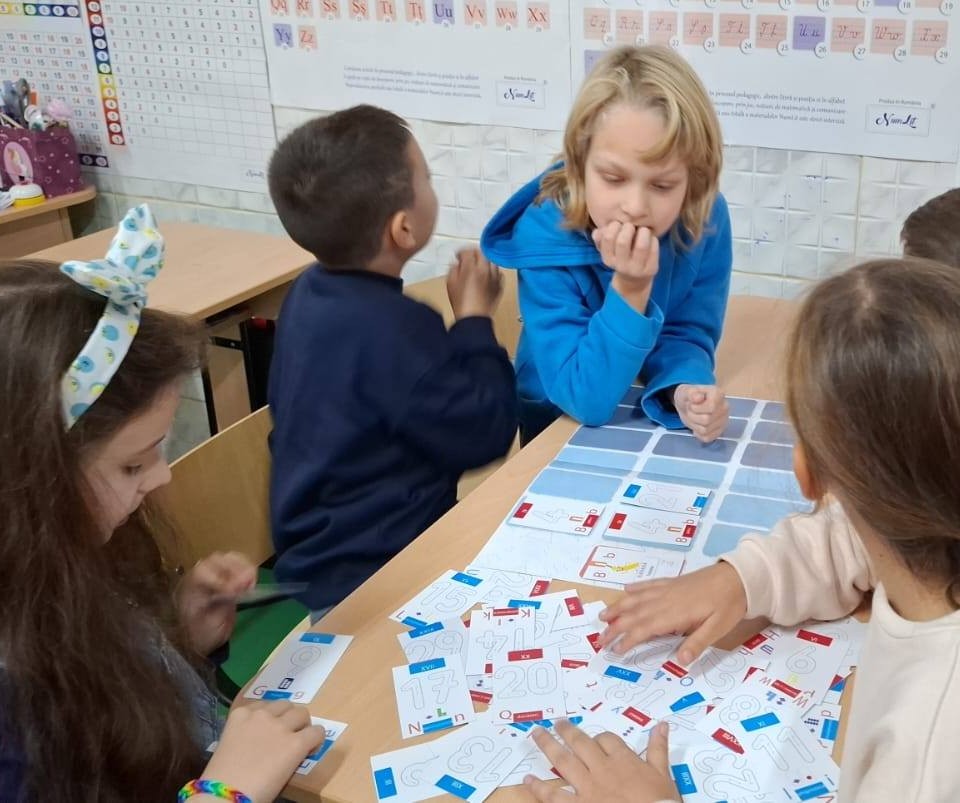
And after ... what comes next?
It happened that one day, a child was standing in front of a page.
There were letters on the page. On another page were numbers. In the notebook there were lines, spaces, signs, requirements, rules.
To an adult, this all seems simple. A letter is a letter. A number is a number. A line must be followed. An exercise must be solved.
But for the child, the beginning of learning can be a very big world.
A world where the hand doesn't always listen.
A world where letters look alike.
A world where numbers must be understood, not just recited.
A world where "come on, write nicely" is not always enough.
A world where the child can come to believe, too soon, that he is not good at school.
And here begins the question that concerns us:
What if learning started not with pressure, but with meaning?
What if letters, numbers, writing and mathematics were not separate pieces, but parts of the same path?
What if a child should not memorize mechanically, but understand, touch, see, trace, compare, make mistakes without fear and come back with confidence?
This is how the NumLit Learning Ecosystem was born.
Not as a mere collection of notebooks.
Not like a set of cards put together.
Not as a quick promise that a child will learn overnight.
But as a learning ecosystem built for children who need to understand before they can perform.
Learning needs connections, not separate pieces
NumLit stands for integrated learning for literacy and numeracy. In other words, it helps children build two essential worlds together: the world of letters and the world of numbers.
Because, in reality, the child does not learn fragmented. He doesn't say to himself: "Now I'm developing fine motor skills. Now I'm activating logical thinking. Now I'm working on spatial orientation."
The child learns through everything he does.
When he draws a line, he prepares his hand for writing.
When he follows a shape, he develops his visual attention.
When they associate a color with a number, they create a link.
When he moves a magnet, when he throws a dice, when he completes a route, when he makes up for a mistake, the child learns with his mind, eyes and hands at the same time.
That's why NumLit doesn't separate learning into cold, rigid chunks. They tie it up.
Links writing to movement.
Connect math to visual.
Link the letter to sound, shape and meaning.
Connects number to quantity, color and logic.
Link the gamebook.
It links the physical material to the digital application.
Connect the exercise to the child's joy that he "succeeded".
From pressure to progress? The child's natural rhythm
One of the biggest problems with starting school is not that a child can't learn.
Most of the time, maybe.
But it needs clearer steps.
It needs time.
He needs materials to help him, not block him.
He needs to feel that the mistake does not make him "inept", but helps him try again.
He needs meaningful learning.
In early and primary education, children often encounter pressure to perform before understanding. They are asked to write, before the hand is prepared. They are asked to read, before the letters make sense. They are asked to calculate, before the number is seen, felt and understood.
Then comes frustration, fatigue, refusal, comparisons and that "I can't" said too quickly by a child who, in fact, has not yet been given the right path for him.
NumLit proposes a different rhythm.
A progressive, gentle and structured rhythm.
The child starts from the concrete. From image, color, shape, movement, drawing, play. Then it goes gradually to symbol, rule, writing, calculation, reading and autonomy.
We don't skip steps.
We don't force the child to look ready.
We help him to become ready.
Herein lies the difference.
Writing is not just treated as repeating letters. It is formed by control, orientation, movement and guided exercise.
Mathematics is not introduced just by memorizing numbers or results. It is built visually, intuitively, from concrete quantities to understanding and abstraction.
Play is not a break from learning. It is a way through which the child actively participates, discovers and retains more easily.
Materials are not intended for one use and then forgotten. Many of them can be taken up, reused, combined, adapted and used at home or in the classroom, depending on the child's pace.
This is how trust comes about.
Not out of empty praise.
Not from pressure.
Not from comparisons.
But from repeated experiences in which the child feels: "I can try. I can understand. I can succeed."
An ecosystem built to... stay
The NumLit ecosystem includes notebooks, reusable boards, aids, magnetic materials, visual aids, educational stickers, games, digital apps and structured learning paths.
But beyond all that, NumLit is a simple idea:
The child learns better when learning makes sense to him.
When he is not only made to copy, but is helped to observe.
When he is not only made to memorize, but is helped to link the information.
When it is not only corrected, but guided.
When it is not rushed, but accompanied.
NumLit is aimed at children from early education to primary school, parents who want to help without putting pressure, teachers looking for clear and coherent materials, but also schools or educational projects that want modern, structured and adaptable tools.
For a child, the impact is not just on the page.
It shows in the way he holds the pencil more securely.
In the way he reads with more courage.
The way he starts to understand a number, not just say it.
In the way they accept to make mistakes and try again.
In the way they gain autonomy.
In the way that learning no longer seems like a struggle.
NumLit does not promise quick miracles.
Promise construction.
Step by step.
Be patient.
Makes sense.
With materials that work together.
With respect for the child's rhythm.
With confidence in the fact that good education is not rushed, but settled.
Because in the end, we don't just want copies that fill out a page correctly.
We want kids who understand what they are doing.
Children who have the courage to think.
Children who are not afraid of letters, numbers, writing or mathematics.
Children who discover that learning can be clear, natural and even enjoyable.
This is the direction of the NumLit Learning Ecosystem.
Learning with meaning.
Learning that builds.
Learning that stays.